S_MT PASS-05 — Montana bond, insurance, and alternative-security component
Fresh research session: October 25, 2026, Pacific / October 26, 2026, UTC
Actual model/mode: GPT-5.6 Sol Pro, regular Chat
Relationship to prior work: Focused security component following saved P1–P3. This is not an independent review. The unreviewed P4 funds work is not treated as accepted authority or relied on for any conclusion here.
Component status: PARTIAL. The governing statutory amounts, core triggers, Part 20 bond-rule adoption, and Part 21 insurance checklist are established. The current official DMP application and bond form could not be fetched; therefore, current form-specific cancellation, claim-tail, aggregate-liability, surety-authorization, and any additional DMP liability/fidelity-insurance requirements remain held.
Executive findings
Montana uses two different security instruments:
- A provider subject to the Montana Consumer Debt Management Services Act, Part 20, must obtain a surety bond for the benefit of consumers harmed by a Part 20 violation. The statute sets $50,000 for an applicant without a staffed Montana counseling office, and ARM 23.19.1002 makes the bond for an applicant with such an office the same. The qualified current result is therefore a $50,000 bond for either model. The bond is evidence required both for initial licensing and annual renewal. Montana Code Annotated+1
- A qualifying noncustodial Part 21 debt-settlement provider must maintain insurance covering dishonesty, fraud, theft, and other misconduct by its directors, officers, employees, and agents. The insurer must be rated at least A- or equivalent by a nationally recognized rating organization; coverage must be at least $100,000; the deductible may not exceed $10,000; and replacement requires at least 30 days’ advance written notice to the attorney general. Montana Code Annotated+1
Those instruments are not interchangeable. A Part 21 provider cannot replace its required misconduct insurance with a surety bond merely because the bond amount is substantial. A Part 20 provider cannot rely on a Part 21 misconduct policy instead of its statutory bond.
No cash deposit, letter of credit, net-worth substitution, pledged account, certificate of deposit, blanket affiliate bond, or other alternative security was verified in the operative Part 20 statute, ARM 23.19.1002 text, Part 21 statute, or accessible official checklists. Because the complete current DMP application and bond form were inaccessible, the proper conclusion is no verified alternative, not that the department is legally forbidden from ever considering one.
A. Substantive answers
1. Covered models and security triggers
Part 20 — debt management and covered credit counseling
Part 20 applies to a person providing or offering DMPs to Montana residents. The central defined DMP is a written arrangement under which a credit counseling service receives consumer money for creditor distribution. “Person” includes a qualifying nonprofit organization. The exclusions for banks, escrow businesses, attorneys, CPAs, and debt collectors are activity- and status-dependent; a nonprofit label, attorney affiliation, remote headquarters, or processor relationship is not a security exemption by itself. Montana Code Annotated+1
A Part 20 applicant must show, for initial licensing and annual renewal, that it has obtained the required surety bond. The bond is for consumers harmed by violations of Part 20. Failure to satisfy this licensing condition permits the department to refuse, suspend, or revoke the license, although the statute does not establish that suspension occurs automatically at the instant a bond lapses. Montana Code Annotated
The previously preserved standalone-counseling qualification remains unchanged: genuinely standalone counseling that never crosses Part 20’s defined DMP-provider entry point may fall outside this bond requirement, but the historical agency response is not a universal safe harbor. A mixed provider that provides or offers DMPs cannot remove its counseling operations from the licensing and security framework merely by separating labels, staff, or webpages.
Part 21 — noncustodial settlement
Part 21 defines a settlement provider as a compensated provider that does not, in its usual and regular course, hold, receive, or disburse debtor funds in connection with settlement. It excludes an entity subject to Part 20. Thus, for the same entity, a properly classified Part 20 operation is not also a Part 21 provider merely because it negotiates creditor concessions. Montana Code Annotated
Part 21’s security is misconduct insurance—not a DMP surety bond. The security trigger attaches to the debt settlement provider, and the covered misconduct actors are expressly its directors, officers, employees, and agents. The statute does not expressly impose a separate $100,000 policy for every office, employee, agent, or consumer. Nor does it affirmatively state that one provider’s policy covers separately incorporated affiliates or contractors that are themselves providers.
Hybrid or third-party arrangements
A provider handling consumer funds may lose the factual predicate for Part 21, but that does not automatically confer a valid Part 20 license or make a $50,000 bond sufficient. Classification still depends on the actual services, contracts, custody, agency, and entity structure.
Likewise:
- A processor’s insurance does not necessarily satisfy the provider’s obligation.
- A parent-company policy does not necessarily cover each subsidiary.
- An “additional insured,” fidelity-bond, crime-policy, E&O, or blanket-bond label does not demonstrate that every statutorily required actor and risk is covered.
- An independent administrator does not remove the provider’s own Part 21 insurance obligation.
- An attorney or nonprofit connection does not establish an exclusion unless the complete statutory conditions are met.
Model-by-security matrix
| Business model |
Security trigger |
Verified instrument and amount |
Beneficiary or covered persons |
Principal unresolved issue |
| Covered custodial DMP provider serving Montana residents |
Part 20 license or annual renewal |
$50,000 surety bond, qualified current conclusion |
Bond is for benefit of consumers harmed by Part 20 violations |
Current official bond form, surety qualifications, aggregate, and claims procedure |
| Part 20 provider with staffed Montana office |
Statute delegates amount to rule |
Same $50,000 bond as provider without such office |
Same consumer-benefit purpose |
Official current rule body inaccessible; supported by adoption chain and matching current reproduction |
| Part 20 provider without staffed Montana office |
Express statutory amount |
$50,000 surety bond |
Consumers harmed by Part 20 violation |
Current form and continuation requirements |
| Genuine standalone counseling-only entity outside defined Part 20 entry point |
No Part 20 trigger established on the bounded facts |
No Part 20 bond established |
— |
Holding out, compensation, affiliate, referral, and mixed-service facts |
| Qualifying noncustodial Part 21 settlement provider |
Part 21 provider status |
Misconduct insurance: at least $100,000; deductible no more than $10,000 |
Misconduct of directors, officers, employees, and agents |
Policy form, insured/loss-payee status, occurrence/aggregate structure, exclusions, and claim rights |
| Attorney, CPA, bank, escrow, creditor, or other excluded model |
Depends on complete exclusion facts |
No exemption or alternative-security result from label alone |
Depends on actual entity and activity |
Professional status, ordinary-practice/incidental-service conditions, authorization, and affiliate facts |
| Affiliate or processor performs regulated activity |
Entity-specific classification |
No verified blanket group security rule |
Policy or bond wording controls |
Whether affiliate is agent, separate provider, additional insured, or separately bonded |
| Custodial “settlement” model not satisfying Part 20 definitions |
No lawful classification established |
Neither instrument presumed sufficient |
— |
Full classification and other licensing law required |
Claims: S_MT-P5-C001–C008, C020–C022.
2. Exact Part 20 bond requirements
Amount
Section 30-14-2004(2)(d) provides that:
- The applicant must obtain a surety bond.
- It is for consumers harmed by violations of Part 20.
- Amount, form, and duration are otherwise as required by department rule.
- An applicant without a Montana office staffed by a counselor must post $50,000. Montana Code Annotated
ARM 23.19.1002 states that the bond for a provider with a staffed Montana office is the same as for a provider without one. Combined with the statutory $50,000 figure, that produces a $50,000 bond for both configurations. Legal Information Institute
No verified provision varies the bond by:
- Consumer count.
- Enrolled principal.
- Monthly receipts.
- Maximum trust balance.
- Number of locations.
- Number of counselors.
- Prior claims.
- Revenue.
- Net worth.
- Custodial volume.
No indexing, inflation adjustment, minimum-to-maximum sliding scale, department discretion above $50,000, or waiver appears in the read statute or ARM 23.19.1002 text.
Official rule history
The official December 2005 proposal designated the parity provision as New Rule II. The January 2006 adoption notice adopted Rules I through V, making changes only to Rules I and III; New Rule II was therefore adopted as proposed. The February 2006 transfer notice renumbered former ARM 2.61.1002 as ARM 23.19.1002. Montana SOS+2
The current official Montana rules index still identifies a “Bond Requirement” in the consumer-debt-management subchapter. Its current body returned HTTP 405. A current secondary compilation reproduces the original one-clause parity rule and records a January 27, 2006 effective date and February 10, 2006 transfer. Montana Administrative Rules+1
Currentness result: The $50,000 conclusion is strongly supported, but it remains official-body access qualified. Historical adoption plus the current index and matching current secondary text are not treated as a certified export of the complete 2026 ARM.
Applicant, locations, agents, and affiliates
The statute attaches the obligation to the license applicant. It does not expressly require:
- A separate bond for every location.
- A separate bond for every counselor or employee.
- One bond per trust account.
- One bond per affiliate.
- A parent guarantee.
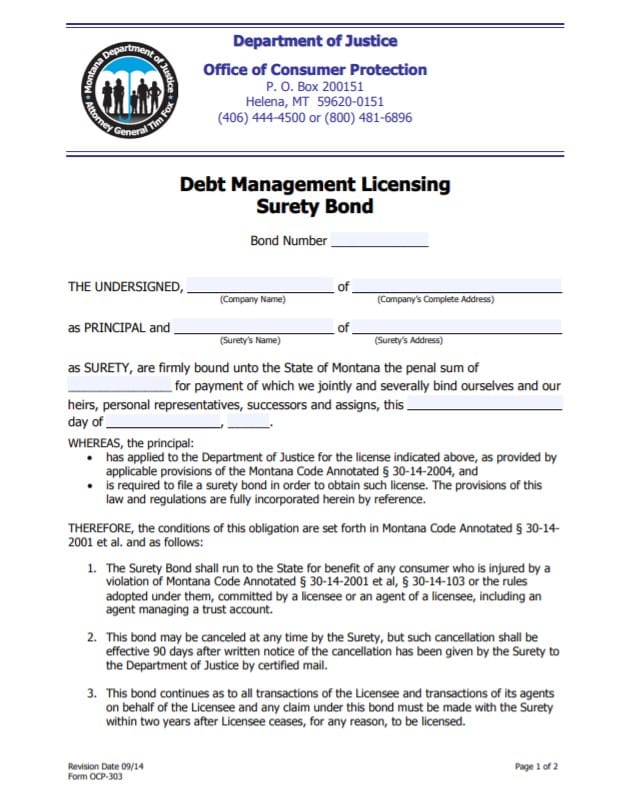
The historical OCP-303 specimen identifies the licensed company as principal. Its first condition states that the bond runs to the State for consumers injured by violations committed by the licensee or an agent, including an agent managing a trust account. That is useful form-history evidence, but the current form was not authenticated. BondExchange+1
Surety qualification
Neither §30-14-2004 nor the retrieved text of ARM 23.19.1002 specifies:
- A minimum financial-strength rating.
- A named rating agency.
- An admitted-insurer requirement.
- Treasury-listing status.
- A Montana certificate of authority.
- Reinsurance requirements.
Those conditions may appear in the current form, general Montana insurance law, or internal filing review, but they were not established here. Requirements from Montana’s separate escrow or telemarketing bond statutes cannot be imported into the DMP bond by analogy.
DMP professional liability, E&O, fidelity, or crime insurance
No Part 20 statutory clause or verified ARM provision read in this pass requires separate professional-liability, E&O, fidelity, or crime insurance. Section 30-14-2013’s prohibition on charging for or providing credit insurance concerns a consumer credit product and is not a provider fidelity-insurance mandate. Montana Code Annotated
A commercial bond article claims that the DMP application requests “liability or fidelity” insurance, but the article is secondary and does not state a limit. The official A-301 application PDF returned HTTP 502, and no official searchable copy of that clause was recovered. That alleged operational requirement is therefore held, not accepted and not rejected. BondExchange
3. Exact Part 21 insurance requirements
Covered conduct and actors
The provider must maintain insurance for:
- Dishonesty.
- Fraud.
- Theft.
- Other misconduct.
The statutorily identified actors are directors, officers, employees, and agents. The insurer must be rated at least A- or equivalent by a nationally recognized rating organization. The provider must make proof available to the attorney general on request. Montana Code Annotated
The statute does not call this:
- A surety bond.
- Professional liability insurance.
- Errors-and-omissions insurance.
- A fidelity bond.
- Commercial crime insurance.
- Fiduciary liability insurance.
- General liability insurance.
A policy may be marketed under one of those labels, but legal sufficiency depends on whether its operative coverage meets §30-14-2102, not its product name.
The phrase “other misconduct” does not establish that every negligent act, contract breach, fee dispute, creditor failure, cyber incident, or settlement-performance loss is insured. Actual insuring agreements, definitions, exclusions, causation provisions, and endorsements are necessary.
Amount and deductible
The statutory requirements are:
Minimum coverage=$100,000\text{Minimum coverage} = $100{,}000Minimum coverage=$100,000Maximum deductible=$10,000\text{Maximum deductible} = $10{,}000Maximum deductible=$10,000The statute itself does not say whether $100,000 is:
- Per occurrence.
- Per claim.
- Per consumer.
- Per policy period.
- Annual aggregate.
- Shared among all insured actors.
The official OCP-801 checklist, revision 02/19, instructs applicants to prove $100,000 per occurrence with a deductible no greater than $10,000 per occurrence. It also requires the insurer name, rating agency, declarations page, and a description of prior claims alleging the specified misconduct. Montana Department of Justice+1
That form-level “per occurrence” language is meaningful operational evidence. It is not silently converted into a legislative amendment or a complete aggregate-limit rule. The checklist does not state whether an annual aggregate may equal $100,000, must exceed it, or may be absent.
Insurer and rating organization
The statute requires at least an A- or equivalent rating from a nationally recognized rating organization. It does not identify a specific organization such as A.M. Best, S&P, Moody’s, or Fitch. The checklist requires the applicant to name the rating agency. Montana Code Annotated+1
Neither the statute nor the checklist passage read here expressly states:
- That the insurer must be Montana-domiciled.
- That the insurer must be admitted in Montana.
- That surplus-lines coverage is prohibited or permitted.
- That a risk-retention group is acceptable.
- That self-insurance is acceptable.
- That a captive is acceptable.
General insurance-law questions remain outside this component unless an actual proposed policy makes them material.
Financial statement, filing charge, and security
The annual financial statement and $250 filing charge are separate from misconduct insurance. A financial statement is not alternative security, and payment of the filing charge does not satisfy the insurance requirement. Likewise, no minimum net worth was identified in §30-14-2102. Montana Code Annotated
4. Current applications, forms, and operational materials
Part 20 DMP route
The DOJ’s current search-rendered page, updated October 2, 2026, tells DMP applicants to submit a $50,000 surety-bond form completed by a bonding company. The direct page was inaccessible, so this is search-rendered operational evidence rather than a freshly opened application page. Montana Department of Justice+1
The official application route identified publicly was:
https://media.dojmt.gov/wp-content/uploads/A-301-Debt-Management-Licensing-Application.pdf
It returned HTTP 502. No content from that application is treated as read. (Invalid URL)
An older official bond route was:
https://files.doj.mt.gov/wp-content/uploads/2011/05/ocp-3031.pdf
It also returned HTTP 502. (Invalid URL)
A secondary-hosted image displays page 1 of an apparent official Debt Management Licensing Surety Bond, Form OCP-303, revision 09/14. It identifies:
- The company as principal.
- A bonding company as surety.
- The State of Montana as obligee.
- Consumers injured by violations as beneficiaries.
- Licensee and agent conduct, expressly including an agent managing a trust account.
- A surety cancellation provision using 90 days’ certified-mail notice to DOJ.
- A claim period extending two years after the licensee ceases to be licensed.
Only page 1 of 2 was recovered, and its current mandatory status was not authenticated. No current conclusion about signatures, power of attorney, aggregate liability, renewal, reinstatement, rider language, or page-2 conditions rests on that specimen. BondExchange
Part 21 settlement route
The current DOJ page’s search rendering links the Debt Settlement Application and Registration Checklist. The linked official OCP-801 PDF was directly opened; it is eight pages and marked revision 02/19. Insurance Verification appears on printed page 2, zero-based PDF index 1. Montana Department of Justice+2
The form requires:
- Yes/no confirmation of misconduct insurance.
- Insurer identity.
- Confirmation of an A- or equivalent rating.
- Rating-agency identity.
- Proof of $100,000 per-occurrence coverage.
- Proof of no more than a $10,000 per-occurrence deductible.
- A declarations page.
- Details of prior misconduct claims, including date, nature, amount, and disposition or pending status. Montana Department of Justice+1
No separate official policy specimen, mandatory endorsement, certificate form, cancellation rider, replacement rider, claims form, or proof-of-loss form was found. OCP-801 requests evidence; it is not itself the insurance contract.
5. Commencement, continuity, replacement, lapse, and claims
Part 20 bond timing
The applicant must provide evidence of the bond to obtain and annually renew the license. The bond is therefore a recurring qualification, not a one-time launch document. Montana Code Annotated
The operative statute does not provide a numeric cancellation-notice period. The historical OCP-303 specimen uses a 90-day period after certified-mail notice to DOJ. Because the current form was not recovered, that 90-day term is a historical form condition, not certified 2026 form text. BondExchange
If the bond ends without compliant replacement:
- The provider no longer has evidence of a required licensing condition.
- The department may refuse, suspend, or revoke under §30-14-2004(4).
- No automatic suspension date, cure period, emergency continuation, or grace period was verified.
- No authority was found allowing consumer business to continue merely because cancellation notice remains pending. Montana Code Annotated
Part 21 insurance timing
The command is to maintain coverage. That indicates continuing coverage rather than proof only on the annual filing date. If the coverage is being replaced, the provider must provide the attorney general at least 30 days’ advance written notice. Montana Code Annotated
The statute does not expressly provide:
- A replacement grace period.
- A cancellation or nonrenewal notice period where no replacement is arranged.
- A provider-to-consumer notice.
- A policy tail.
- An extended reporting period.
- A run-off policy requirement.
- Automatic registration expiration or suspension.
- Retroactive-date requirements.
A gap between policies is not cured merely because the provider sent a replacement notice. The obligation is to maintain the insurance.
Occurrence versus claims-made
Neither §30-14-2102 nor OCP-801 identifies the policy as occurrence-made or claims-made. The checklist’s “per occurrence” limit language does not necessarily determine when a claim must be made or reported.
The following remain policy-dependent:
- Definition of “occurrence.”
- Related-acts aggregation.
- Discovery period.
- Retroactive date.
- Notice of circumstances.
- Claims-made reporting deadline.
- Tail coverage.
- Prior-acts exclusion.
- Pending-and-prior-litigation exclusion.
Who may claim on the Part 20 bond
The statutory bond is expressly for the benefit of consumers harmed by Part 20 violations. Separately, §30-14-2015 allows a person harmed by a Part 20 violation to sue the violator for actual and consequential damages or $500, whichever is greater, and allows equitable and class relief. That statutory action against the violator is not automatically the same as a direct action against the surety. Montana Code Annotated+1
The historical OCP-303 specimen says a claim must be made with the surety within two years after the licensee ceases to be licensed. It does not, on the recovered page, resolve:
- Whether filing directly with the surety is the exclusive route.
- Whether the State must be joined.
- Whether a civil judgment against the principal is required first.
- Whether claims may be assigned.
- Required proof-of-loss contents.
- Surety investigation deadlines.
- Claimant priority.
- Pro rata distribution after exhaustion.
- Replenishment after a paid claim.
- Annual versus continuous aggregate liability.
Those questions remain held.
Who may claim under Part 21 insurance
Section 30-14-2102 does not identify the consumer as:
- The named insured.
- An additional insured.
- A loss payee.
- A third-party beneficiary.
- A person with a statutory direct action against the insurer.
Section 30-14-2104 allows the attorney general or county attorney to bring enforcement actions and gives debtors the remedies available under Montana consumer-protection law and other state law. It does not state that an insurer must pay a debtor directly or waive policy defenses. Montana Code Annotated
Accordingly, the statutory requirement to maintain insurance does not itself guarantee that:
- A particular consumer may present a direct claim.
- Every adjudicated provider liability is insured.
- Restitution is within coverage.
- Civil penalties or fee refunds are covered.
- The insurer is solvent.
- The provider pays the deductible.
- A limit remains unexhausted.
Policy wording and actual claim facts are indispensable.
Cases and orders
Targeted searches were performed using:
- 30-14-2004
- 30-14-2102
- “Debt Management Licensing Surety Bond”
- “for the benefit of consumers harmed”
- “dishonesty, fraud, theft, and other misconduct”
- OCP-303
- The historical bond’s trust-account-agent language
Searches were directed to Montana court, judicial-document, DOJ, and public case-law domains. No decision or administrative order interpreting these particular bond or insurance clauses was located. This is a bounded search result, not proof that no responsive case, sealed matter, district-court decision, settlement, or unpublished order exists. No complete paid citator or all-county docket review was performed.
B. Amount, event, and recovery-boundary matrix
| Question |
Part 20 bond |
Part 21 insurance |
| Instrument |
Surety bond |
Insurance |
| Core trigger |
Covered Part 20 applicant/licensee |
Qualifying Part 21 settlement provider |
| Amount |
$50,000, qualified current result |
At least $100,000 |
| Deductible |
No statutory or verified rule deductible |
No more than $10,000 |
| Formula |
Flat amount; no verified volume formula |
Flat statutory minimum; operational form says per occurrence |
| Applicant or provider level |
Applicant must obtain bond |
Provider must maintain coverage |
| Locations |
No separate amount per location identified |
No separate amount per location identified |
| Agents |
Statute protects consumers harmed by Part 20 violations; historical form expressly includes agent conduct |
Directors, officers, employees, and agents expressly covered actors |
| Affiliates |
Not automatically covered |
Not automatically covered |
| Obligee |
Historical form identifies State of Montana |
Not specified as a surety obligee |
| Consumer beneficiary |
Express statutory bond purpose |
No direct insured/beneficiary status specified |
| Issuer rating |
No verified bond-surety rating in Part 20 text |
A- or equivalent from nationally recognized rating organization |
| Proof |
Evidence required for initial and annual license renewal |
Proof available to AG on request; OCP-801 asks for declarations and proof |
| Replacement notice |
No statutory number; historical form says 90 days after certified notice |
At least 30 days’ advance written notice to AG if replaced |
| Cancellation/nonrenewal |
Current form unresolved |
No separate statutory rule beyond maintenance and replacement notice |
| Tail |
Historical form suggests two years after license cessation |
No statutory tail |
| Per claim/occurrence |
Not specified in read statute/rule |
Statute silent; checklist says per occurrence |
| Aggregate |
Not established |
Not established |
| Replenishment |
Not established |
Not established |
| Waiver |
None verified |
None verified |
| Cash/LOC substitute |
None verified |
None verified |
| Net-worth substitute |
None verified |
None verified |
| Government charge |
Separate $1,000 license charge preserved from P2; not security |
Separate $250 filing charge; not security |
| Financial statement/audit |
Annual independent CPA audit is separate |
Annual financial statement and possible CPA review are separate |
| Actual provider compliance |
Not established |
Not established |
C. Bounded security examples
All figures are U.S. dollars. Arithmetic is exact to the cent. Each example assumes a valid claimant, covered conduct, timely compliance, a solvent issuer, and no applicable exclusion only where expressly stated. None guarantees recovery or approves a provider.
Example 1 — One valid Part 20 bond claim
Assumptions
- Provider is subject to Part 20.
- Current valid bond amount: $50,000.
- A consumer establishes a covered bond loss of $18,000.
- No competing claims.
- No form defense or exclusion.
- The current bond permits payment.
Calculation:
$50,000−$18,000=$32,000$50{,}000 - $18{,}000 = $32{,}000$50,000−$18,000=$32,000The consumer’s established loss is below the face amount. The potential payment is $18,000.
The remaining $32,000 is not established as legally restored or available for future claims, because current aggregate and replenishment terms were not verified.
No deductible was identified in the Part 20 statute or rule. A surety’s separate indemnity rights against the provider do not create a consumer deductible.
Example 2 — Multiple Part 20 claims and conditional aggregate
Hypothetical valid claims
- Consumer A: $12,000.
- Consumer B: $20,000.
- Consumer C: $25,000.
Total:
$12,000+$20,000+$25,000=$57,000$12{,}000 + $20{,}000 + $25{,}000 = $57{,}000$12,000+$20,000+$25,000=$57,000Illustrative assumption only: the current bond’s aggregate liability for all claims is limited to its $50,000 penal sum.
Then:
$57,000−$50,000=$7,000$57{,}000 - $50{,}000 = $7{,}000$57,000−$50,000=$7,000At least $7,000 lies outside the assumed bond aggregate. It may remain provider liability under other law, but recovery is not guaranteed.
This example does not decide:
- Which claimant is paid first.
- Whether payments are pro rata.
- Whether the bond replenishes at renewal.
- Whether each license year creates a separate aggregate.
- Whether related claims are combined.
Those questions require the current complete bond.
Example 3 — Part 21 deductible on a $60,000 loss
Assumptions
- Covered misconduct loss: $60,000.
- Applicable occurrence limit: $100,000.
- Applicable deductible: $10,000.
- Policy makes the provider responsible for the deductible.
- No exclusion or defense.
Potential insurer amount:
$60,000−$10,000=$50,000$60{,}000 - $10{,}000 = $50{,}000$60,000−$10,000=$50,000Potential provider-retained amount:
$10,000$10{,}000$10,000Total addressed:
$50,000+$10,000=$60,000$50{,}000 + $10{,}000 = $60{,}000$50,000+$10,000=$60,000The statutory deductible ceiling does not itself say who advances or ultimately bears the $10,000. That is an explicit policy and liability assumption.
Example 4 — Loss above the Part 21 per-occurrence form limit
Assumptions
- Covered loss: $130,000.
- $100,000 per-occurrence limit from OCP-801.
- $10,000 deductible.
- Insurer’s maximum payment is calculated after applying the deductible.
- No larger umbrella or excess policy.
Amount after deductible:
$130,000−$10,000=$120,000$130{,}000 - $10{,}000 = $120{,}000$130,000−$10,000=$120,000Insurer maximum:
min($120,000, $100,000)=$100,000\min($120{,}000,\ $100{,}000)=$100{,}000min($120,000, $100,000)=$100,000Amount not funded by that policy:
$130,000−$100,000=$30,000$130{,}000 - $100{,}000 = $30{,}000$130,000−$100,000=$30,000That $30,000 consists of the assumed $10,000 deductible plus $20,000 above the assumed policy limit. Provider liability and actual recovery remain separate questions.
Example 5 — Multiple Part 21 occurrences and unknown aggregate
Hypothetical covered occurrences
- Occurrence A loss: $90,000.
- Occurrence B loss: $80,000.
- Deductible per occurrence: $10,000.
After deductibles:
$90,000−$10,000=$80,000$90{,}000-$10{,}000=$80{,}000$90,000−$10,000=$80,000$80,000−$10,000=$70,000$80{,}000-$10{,}000=$70{,}000$80,000−$10,000=$70,000Combined insurer-side calculation before any aggregate:
$80,000+$70,000=$150,000$80{,}000+$70{,}000=$150{,}000$80,000+$70,000=$150,000Branch 1 — no separate annual aggregate below that amount: potential insurer payments total $150,000.
Branch 2 — policy has a $100,000 annual aggregate: potential insurer payments are capped at $100,000, leaving:
$150,000−$100,000=$50,000$150{,}000-$100{,}000=$50{,}000$150,000−$100,000=$50,000outside the assumed aggregate, in addition to the two $10,000 deductibles already removed.
Montana’s statute and the checklist passage do not resolve which branch is correct.
Example 6 — Part 21 replacement notice and continuity
Use relative days rather than a calendar-count assumption.
- Day 0: provider gives written replacement notice to the attorney general.
- Day 20: old policy terminates.
- Day 30: new policy begins.
Although 30 days’ notice preceded the replacement date, there is a 10-day coverage gap:
30−20=10 days30-20=10\text{ days}30−20=10 daysBecause the statute requires the provider to maintain coverage, notice alone does not make the gap compliant.
A continuity-preserving illustration would keep the old policy effective through the new policy’s commencement, subject to actual policy times, cancellation provisions, and regulator treatment.
Example 7 — Part 20 historical cancellation condition
Historical-form assumption only
- Day 0: surety sends the specimen’s required certified-mail cancellation notice.
- Day 90: cancellation becomes effective under the 2014 specimen.
- Replacement bond becomes effective on Day 90 with no timing gap.
This avoids an arithmetic gap:
90−90=0 days90-90=0\text{ days}90−90=0 daysIt does not prove the current form still uses 90 days or that the agency would accept a replacement becoming effective at the last instant. If replacement instead begins Day 95, the gap is:
95−90=5 days95-90=5\text{ days}95−90=5 daysDuring that five-day interval, the provider lacks established compliance with the bond condition. Exact suspension, cessation, and cure consequences remain unresolved.
Example 8 — Custodial versus noncustodial security
Model A: covered DMP
- Provider receives consumer funds for creditor distribution.
- Part 20 applies absent an actual exclusion.
- Required security: qualified $50,000 consumer-benefit surety bond.
Model B: qualifying noncustodial settlement
- Provider negotiates settlement but does not ordinarily hold, receive, or disburse settlement principal.
- Part 21 applies absent an actual exclusion.
- Required security: $100,000 minimum misconduct insurance, deductible no more than $10,000.
A $100,000 Part 21 insurance policy does not replace Model A’s $50,000 surety bond. A $50,000 bond does not replace Model B’s insurance.
D. PASS-05 source table
| Source ID |
Title, issuer, literal URL, pinpoint, version/status |
Actual access and limits |
| S_MT-P5-S001 |
Montana Consumer Debt Management Services Act, Montana Legislature, MCA 2025. Scope: https://mca.legmt.gov/bills/mca/title_0300/chapter_0140/part_0200/section_0020/0300-0140-0200-0020.html, §30-14-2002(1)–(2). Definitions: https://mca.legmt.gov/bills/mca/title_0300/chapter_0140/part_0200/section_0030/0300-0140-0200-0030.html, §30-14-2003(1)–(7). Licensing/bond: https://mca.legmt.gov/bills/mca/title_0300/chapter_0140/part_0200/section_0040/0300-0140-0200-0040.html, §30-14-2004(1)–(4). Prohibited practices: https://mca.legmt.gov/bills/mca/title_0300/chapter_0140/part_0200/section_0130/0300-0140-0200-0130.html, §30-14-2013. Remedies: https://mca.legmt.gov/bills/mca/title_0300/chapter_0140/part_0200/section_0150/0300-0140-0200-0150.html, §30-14-2015. |
Fresh direct official reading, October 25, 2026 Pacific. Official 2025 Internet codification; printed-code disclaimer applies. §2004 history identifies 2005 enactment. No comprehensive post-2025 session/special-session audit. Montana Code Annotated+4 |
| S_MT-P5-S002 |
ARM 23.19.1002 — Bond Requirement, current official Montana SOS subchapter index: https://rules.mt.gov/browse/collections/aec52c46-128e-4279-9068-8af5d5432d74/sections/9b0fc2a6-9f15-4e47-820e-026674139132 |
Fresh search-rendered official route; direct body returned HTTP 405. Confirms current subchapter includes the bond requirement, but not a complete authenticated current rule body. Montana Administrative Rules |
| S_MT-P5-S003 |
ARM 23.19.1002 — Bond Requirement, Cornell LII secondary reproduction: https://www.law.cornell.edu/regulations/montana/Mont-Admin-r-23.19.1002, clause (1) and history. |
Fresh full-text secondary read. States in-state-office bond is the same as no-office bond; reports NEW effective January 27, 2006 and transfer effective February 10, 2006. Quarterly secondary compilation, not a substitute for inaccessible official current body. Legal Information Institute |
| S_MT-P5-S004 |
Montana Administrative Register 2005, Issue 23, Montana Secretary of State: https://sosmt.gov/wp-content/uploads/attachments/MAR05-23.pdf?dt=1483145115456&dt=1503068948958&dt=1519326121561. New Rule II at printed p.2373, zero-based PDF index 3; supporting reason continues printed pp.2373–2374, PDF indices 3–4. |
Fresh official PDF inspection of bounded pages. Proposal only; not treated as adoption by itself. Montana SOS+1 |
| S_MT-P5-S005 |
Montana Administrative Register 2006, Issue 2 — adoption of MAR Notice 2-61-175, Montana Secretary of State: https://sosmt.gov/wp-content/uploads/attachments/MAR06-02.pdf?dt=1485893209495&dt=1503068970743&dt=1519326146392. Printed pp.207–209, zero-based PDF indices 97–99. |
Fresh official PDF inspection of complete adoption segment. Rules I–V adopted; stated changes only to I and III, leaving Rule II unchanged. Published January 26, 2006. Montana SOS+2 |
| S_MT-P5-S006 |
Montana Administrative Register 2006, Issue 3 — Consumer Protection transfer, Montana Secretary of State: https://sosmt.gov/wp-content/uploads/attachments/MAR06-03.pdf?dt=1485893209495&dt=1503068970743&dt=1519326146392. Printed pp.322–323, zero-based PDF indices 52–53. |
Fresh official PDF inspection of complete transfer segment. Maps 2.61.1002 to 23.19.1002. Transfer-publication history is not a new substantive bond amount. Montana SOS+1 |
| S_MT-P5-S007 |
Debt Management and Debt Settlement Businesses, Montana DOJ Office of Consumer Protection: https://dojmt.gov/office-of-consumer-protection/debt-management-and-debt-settlement-businesses/ |
Fresh official search-rendered operational material, displayed update October 2, 2026; direct page inaccessible. States that DMP filing includes a $50,000 surety-bond form completed by a bonding company. Not a live application approval or statutory effective date. Montana Department of Justice+1 |
| S_MT-P5-S008 |
Debt Management Licensing Application, A-301, apparent current Montana DOJ route: https://media.dojmt.gov/wp-content/uploads/A-301-Debt-Management-Licensing-Application.pdf |
Fresh failed route: HTTP 502. Not read. No application clause, insurance requirement, version, page count, or current form conclusion taken from this source. (Invalid URL) |
| S_MT-P5-S009 |
Debt Management Licensing Surety Bond, Form OCP-303, apparent Montana DOJ form. Former official route: https://files.doj.mt.gov/wp-content/uploads/2011/05/ocp-3031.pdf; secondary-hosted page-1 image: https://www.bondexchange.com/wp-content/uploads/Screenshot-2021-07-09-111048.jpg. Revision 09/14, page 1 of 2. |
Former official PDF route failed 502. Secondary-hosted image actually inspected. Historical specimen only; page 2 and current mandatory status not authenticated. (Invalid URL) |
| S_MT-P5-S010 |
Montana MCA 2025, Part 21 — Regulation of Debt Settlement Providers, Montana Legislature. Definition: https://mca.legmt.gov/bills/mca/title_0300/chapter_0140/part_0210/section_0010/0300-0140-0210-0010.html, §30-14-2101. Insurance: https://mca.legmt.gov/bills/mca/title_0300/chapter_0140/part_0210/section_0020/0300-0140-0210-0020.html, §30-14-2102(1). Remedies boundary: https://mca.legmt.gov/bills/mca/title_0300/chapter_0140/part_0210/section_0040/0300-0140-0210-0040.html, §30-14-2104. |
Fresh direct official reading, October 25, 2026 Pacific. Official 2025 Internet codification; histories show 2009 enactment and no amendment note on these pages. No complete post-2025 audit. Montana Code Annotated+2 |
| S_MT-P5-S011 |
Debt Settlement Application and Registration Checklist, Form OCP-801, Montana DOJ Office of Consumer Protection: https://dojmt.gov/wp-content/uploads/Debt-Settlement-Application-and-Registration-Checklist-.pdf. Revision 02/19; insurance Subpart B at printed p.2, zero-based PDF index 1; form identity at printed p.1, PDF index 0. |
Fresh direct official PDF read and screenshot. Eight pages. The current DOJ page search rendering links the checklist, but the form’s revision remains February 2019. It is operational material, not a policy contract or legislative amendment. Montana Department of Justice+3 |
| S_MT-P5-S012 |
Montana Debt Management License Bond: A Comprehensive Guide, BondExchange: https://www.bondexchange.com/montana-debt-management-license-bond-a-comprehensive-guide/ |
Fresh secondary discovery source only. Used solely to identify failed official application/form routes and the unverified lead that an application may request liability or fidelity insurance. Pricing, underwriting, legal interpretations, and provider marketing claims are not relied on as law. BondExchange |
E. PASS-05 claim table
| Claim ID |
Precise claim |
Source and pinpoint |
Conditions, currentness, consequence, and confidence |
| S_MT-P5-C001 |
Imported P1 C009 confirmed: a Part 21 provider must maintain at least $100,000 in misconduct insurance with a deductible no greater than $10,000. |
S010, §2102(1)(a)–(b) |
High for official 2025 text; actual policy and post-2025 audit held. |
| S_MT-P5-C002 |
Part 21 coverage must address dishonesty, fraud, theft, and other misconduct by directors, officers, employees, and agents. |
S010, §2102(1)(a) |
High. Scope of “other misconduct” and policy exclusions unresolved. |
| S_MT-P5-C003 |
Part 21 insurer must be rated at least A- or equivalent by a nationally recognized rating organization. |
S010, §2102(1)(a) |
High. No particular rating organization named. |
| S_MT-P5-C004 |
Provider must furnish proof of Part 21 insurance to the attorney general on request. |
S010, §2102(1)(a) |
High. No statutory proof form specified. |
| S_MT-P5-C005 |
Replacement of Part 21 coverage requires at least 30 days’ advance written notice to the attorney general. |
S010, §2102(1)(b) |
High. Separate cancellation/nonrenewal/lapse notice not established. |
| S_MT-P5-C006 |
Part 21’s statutory text does not label the instrument a surety bond, E&O policy, fidelity bond, crime policy, or general liability policy. |
S010, §2102(1) |
High textual boundary. Product label cannot replace coverage analysis. |
| S_MT-P5-C007 |
OCP-801 instructs applicants to prove $100,000 per-occurrence coverage and no more than a $10,000 per-occurrence deductible. |
S011, Subpart B4, printed p.2/PDF index 1 |
High for form content; moderate for legal consequence. Statute itself does not say “per occurrence.” |
| S_MT-P5-C008 |
OCP-801 requires insurer identity, rating-agency identity, declarations page, and prior misconduct-claim details. |
S011, B1–B6, printed p.2/PDF index 1 |
High for form content. Not a policy or claims-procedure form. |
| S_MT-P5-C009 |
A covered Part 20 applicant must obtain a consumer-benefit surety bond as an initial and annual-renewal condition. |
S001, §2004(2)(d) |
High. Exact current form and issuer conditions held. |
| S_MT-P5-C010 |
Part 20 expressly sets $50,000 for an applicant without a staffed Montana counseling office. |
S001, §2004(2)(d) |
High. |
| S_MT-P5-C011 |
ARM 23.19.1002 makes the staffed-Montana-office bond the same as the no-office bond, producing a qualified $50,000 requirement for both. |
S002–S006 |
High-confidence qualified currentness. Current official body failed; official adoption chain and current reproduction agree. |
| S_MT-P5-C012 |
The Part 20 bond is for consumers harmed by a violation of Part 20. |
S001, §2004(2)(d) |
High. Does not resolve claim procedure or aggregate. |
| S_MT-P5-C013 |
The statute and retrieved rule do not vary the Part 20 bond by volume, consumers, trust balance, locations, revenue, or claims history. |
S001, §2004; S003, ARM 23.19.1002 |
High bounded negative for read provisions; current application held. |
| S_MT-P5-C014 |
No Part 20 cash, LOC, net-worth, deposit, or collateral alternative was verified. |
S001–S003; S007–S009 |
Qualified. Current application/form inaccessible, so no categorical prohibition asserted. |
| S_MT-P5-C015 |
No separate Part 20 E&O, professional-liability, fidelity, or crime-insurance duty was verified from operative statute or rule. |
S001–S003 |
Qualified. Secondary application lead exists, but primary A-301 failed. |
| S_MT-P5-C016 |
Part 20’s prohibition on providing or charging for credit insurance is not a provider fidelity-insurance requirement. |
S001, §2013(1)(f) |
High boundary. |
| S_MT-P5-C017 |
The apparent historical OCP-303 form runs to the State for consumers injured by violations committed by a licensee or agent, including a trust-account agent. |
S009, apparent clause 1, rev. 09/14 p.1 of 2 |
Moderate historical-form confidence; not current certification. |
| S_MT-P5-C018 |
The apparent historical OCP-303 form uses 90-day certified-mail surety cancellation notice and a two-year post-licensure claim period. |
S009, apparent clauses 2–3, rev. 09/14 p.1 of 2 |
Moderate historical-form confidence. Current form and page 2 unavailable. |
| S_MT-P5-C019 |
Failure to comply with the Part 20 bond condition permits license refusal, suspension, or revocation but no automatic lapse procedure was verified. |
S001, §2004(4) |
High statutory authority; exact procedure held. |
| S_MT-P5-C020 |
Part 20 reaches offers of DMPs to Montana residents and includes nonprofits; attorney/CPA/debt-collector exclusions are conditional. |
S001, §§2002–2003 |
High. No label-based security exemption. |
| S_MT-P5-C021 |
Part 21 is limited to the defined noncustodial provider and excludes an entity subject to Part 20. |
S010, §2101(1)–(2) |
High. Hybrid classification remains fact-dependent. |
| S_MT-P5-C022 |
A bond and a misconduct-insurance policy are not statutory substitutes for one another. |
S001 §2004; S010 §2102 |
High textual consequence. |
| S_MT-P5-C023 |
Part 21 does not expressly make the consumer a named insured, additional insured, loss payee, or statutory direct claimant against the insurer. |
S010, §§2102, 2104 |
High bounded negative. Policy and other law may affect actual rights. |
| S_MT-P5-C024 |
Part 21 remedies against the provider do not themselves establish insurance coverage or waive insurer defenses. |
S010, §2104 |
High boundary. Full remedies analysis deferred. |
| S_MT-P5-C025 |
Part 20 separately authorizes consumers harmed by violations to sue the violator; that does not establish the procedure for a direct action against the surety. |
S001, §2015(3)–(6) |
High. Current bond and controlling cases held. |
| S_MT-P5-C026 |
No per-claim, annual-aggregate, exhaustion, priority, pro rata, or replenishment rule was verified for either instrument. |
S001–S011 |
Qualified negative. Complete policies, current bond form, and cases absent. |
| S_MT-P5-C027 |
The $250 Part 21 filing charge and annual financial statement are not alternative consumer security. |
S010, §2102(2) |
High. |
| S_MT-P5-C028 |
The historical Part 20 adoption chain supports the bond parity rule; it does not certify every current form or later operational requirement. |
S004–S006 |
High provenance conclusion. |
| S_MT-P5-C029 |
The 2026 DOJ operational page continues to call for a $50,000 DMP bond form, but the actual current application and bond PDF were not read. |
S007–S009 |
High access qualification. |
| S_MT-P5-C030 |
Targeted searches did not locate a controlling Montana case or public order interpreting these exact security clauses. |
Research log described above |
Bounded unsuccessful search only; no absence conclusion. |
F. Component coverage and gap table
| Component |
Status |
Claim IDs |
Exact remaining evidence or next action |
| Part 20 security trigger |
Answered |
C009–C012, C020 |
Apply to actual service and exclusion facts. |
| Part 20 bond amount |
Qualified answered |
C010–C011 |
Recover current official ARM body or certified rule export. |
| In-state versus out-of-state amount |
Qualified answered |
C010–C011 |
Same current-body gap. |
| Initial licensing bond |
Answered |
C009 |
Inspect current application and bond. |
| Annual-renewal bond evidence |
Answered textually |
C009 |
Verify current renewal form and filing procedure. |
| Part 20 beneficiary |
Answered |
C012 |
Current claims procedure unresolved. |
| Part 20 obligee |
Historical-form evidence only |
C017 |
Recover current official OCP-303. |
| Part 20 covered agents |
Historical-form evidence only |
C017 |
Authenticate current form and apply agency facts. |
| Trust-account manager coverage |
Historical-form evidence only |
C017 |
Authenticate current form; P4 funds conclusions remain unreviewed. |
| Part 20 amount formula |
Answered as flat amount in read law |
C010–C013 |
Check inaccessible current application for discretionary adjustments. |
| Part 20 per-location bond |
No separate requirement verified |
C013 |
Current form and entity-specific application review. |
| Part 20 affiliate coverage |
Unresolved |
C013, C017 |
Obtain organizational chart, principal identity, and bond schedule. |
| Part 20 surety authorization |
Unresolved |
— |
Read current bond form and any applicable general insurance-law clause. |
| Part 20 surety rating |
Unresolved/not stated in read provisions |
— |
Current form and filing instructions. |
| Part 20 power of attorney |
Operational secondary lead only |
— |
Recover current official bond package. |
| Part 20 current form |
Unresolved |
C017–C018, C029 |
Official A-301/OCP-303 routes must become accessible or certified copy obtained through a later authorized route. |
| Part 20 cancellation notice |
Historical 90-day evidence only |
C018 |
Authenticate current form and notice recipient/method. |
| Part 20 replacement |
Unresolved |
C018–C019 |
Current rider, continuation certificate, and agency procedure. |
| Part 20 lapse consequence |
Partial |
C019 |
Determine administrative process, cure, and effective cessation date. |
| Part 20 claim tail |
Historical two-year evidence only |
C018 |
Authenticate current form and triggering event. |
| Part 20 direct claim against surety |
Unresolved |
C025 |
Current bond, Montana surety law, and controlling cases. |
| Part 20 aggregate liability |
Unresolved |
C026 |
Complete current bond, including page 2 and riders. |
| Part 20 claimant priority/pro rata |
Unresolved |
C026 |
Bond language, surety claims procedure, and cases. |
| Part 20 replenishment |
Unresolved |
C026 |
Bond continuation and renewal terms. |
| Part 20 alternative security |
No verified alternative |
C014 |
Current application/rule/form review; no substitution assumed. |
| Part 20 E&O/professional liability |
No primary requirement verified |
C015 |
Recover A-301 and any insurance attachment. |
| Part 20 fidelity/crime coverage |
Secondary lead only |
C015 |
Same primary-source gap. |
| Credit insurance distinction |
Answered |
C016 |
No further work unless actual product offered. |
| Part 21 security trigger |
Answered |
C001–C006, C021 |
Apply definition and exclusions to actual provider. |
| Part 21 covered conduct |
Answered textually |
C002 |
Policy definitions and exclusions remain. |
| Part 21 covered actors |
Answered textually |
C002 |
Contractor/affiliate agency facts remain. |
| Part 21 minimum amount |
Answered |
C001 |
Actual limit and aggregate verification required. |
| Part 21 deductible maximum |
Answered |
C001 |
Who bears deductible and application mechanics require policy. |
| Part 21 insurer rating |
Answered |
C003 |
Verify actual rating and rating organization on target date. |
| Part 21 insurer authorization |
Unresolved |
C003 |
General Montana insurance law and actual carrier status. |
| Part 21 proof on AG request |
Answered |
C004 |
Actual proof and current filing status held. |
| Part 21 per-occurrence treatment |
Operationally supported, legal status qualified |
C007 |
Reconcile actual policy and regulator position with statutory wording. |
| Part 21 annual aggregate |
Unresolved |
C026 |
Declarations, endorsements, and policy. |
| Part 21 declarations-page requirement |
Answered as form procedure |
C008 |
Actual declarations not obtained. |
| Part 21 prior-claims disclosure |
Answered as form procedure |
C008 |
Actual provider claims held. |
| Part 21 replacement notice |
Answered |
C005 |
Exact notice contents, receipt rule, and replacement proof unresolved. |
| Part 21 cancellation/nonrenewal notice |
Unresolved |
C005 |
Policy, general insurance law, and agency procedure. |
| Part 21 continuous coverage |
Answered as obligation, implementation partial |
C005 |
Gap, reinstatement, and replacement facts. |
| Part 21 occurrence versus claims-made |
Unresolved |
C006, C026 |
Full policy and endorsements. |
| Part 21 tail/extended reporting |
Unresolved |
C026 |
Policy and regulator requirements. |
| Part 21 direct consumer claim |
No statutory direct right established |
C023–C024 |
Policy, Montana insurance law, and controlling decisions. |
| Part 21 assignment/joining insurer |
Unresolved |
C023–C024 |
Policy, procedural law, and cases. |
| Part 21 covered restitution/fees/penalties |
Unresolved |
C024 |
Actual policy exclusions and public-policy rules. |
| Part 21 alternative security |
No verified alternative |
C022, C027 |
No bond/cash/net-worth substitution assumed. |
| OCP-801 current linkage |
Answered operationally |
C007–C008 |
Confirm whether a post-02/19 revision exists. |
| Standard insurance certificate/rider |
Unresolved/not located |
C008 |
Current DOJ filing package and insurer forms. |
| Current named-provider coverage |
Excluded/unresolved |
All |
Entity-specific declarations, endorsements, insurer rating, dates, and claims. |
| Controlling cases/orders |
Unresolved after bounded search |
C030 |
Full citator, district-court, administrative-file, and docket review. |
| Comprehensive post-2025 amendment audit |
Unresolved |
All |
Session laws, special sessions, future-effective laws, and rule notices. |
| P4 funds interpretations |
Expressly not accepted here |
— |
Separate coordinator review required. |
| Full insurance-policy interpretation |
Excluded |
— |
Requires actual policy; no private document requested or obtained. |
| Bond indemnity agreement and underwriting |
Excluded |
— |
Commercial agreement, not current public legal permission. |
| Bankruptcy, priority, insolvency, and insurer liquidation |
Deferred |
— |
Separate required pass. |
| Full agreements and remedies |
Deferred except necessary boundaries |
C024–C025 |
Separate contract/remedies passes. |
| Fees, collections, limitations, litigation, garnishment, secured debt, sectors, local, tribal, country, and parent-state dimensions |
Excluded |
— |
All remain required and unaccepted. |
G. Researcher self-check
Freshly and directly read
- Official 2025 MCA §§30-14-2002, 2003, 2004, 2013, and 2015.
- Official 2025 MCA §§30-14-2101, 2102, and 2104.
- The bounded official Montana Administrative Register pages containing:New Rule II proposal.Adoption of Rules I–V.Transfer and renumbering to ARM 23.19.1002.
- The complete relevant insurance page of official OCP-801, revision 02/19, with PDF screenshots.
- Current secondary text of ARM 23.19.1002.
- Current DOJ search-rendered operational instructions concerning the $50,000 DMP bond form.
Freshly accessed but failed or incomplete
- Current official ARM consumer-debt-management body: HTTP 405.
- Current official A-301 DMP application: HTTP 502.
- Former official OCP-303 bond PDF: HTTP 502.
- Direct current DOJ debt-management/debt-settlement page: inaccessible; only official search rendering was usable.
- Only page 1 of 2 of a secondary-hosted historical OCP-303 specimen was available.
Discovery-only or secondary material not treated as controlling
- BondExchange’s claims about DMP liability/fidelity insurance, premiums, underwriting, power of attorney, and commercial bond practices.
- Surety-company marketing descriptions.
- Search-result descriptions of current filing routes.
- The 2014 OCP-303 image as current-form proof.
- Any provider marketing statement or claimed license number.
Reused without changing prior provenance
- P1 C009’s original official 2025 §30-14-2102 read.
- P1–P3 provider-access, fee, scope, and date-correction findings.
- The qualified P2 standalone-counseling reconciliation.
- Historical P1/P2 source, claim, coverage, and example tables.
No prior access date was retroactively changed or reclassified as a fresh PASS-05 reading.
Not read or resolved
- Complete current official ARM bodies and any unpublished license conditions.
- Current complete DMP application and bond form.
- Any actual insurer policy, declaration, endorsement, binder, cancellation notice, surety power of attorney, indemnity agreement, or claim file.
- Any named provider’s bond, policy, license, registration, or claim history.
- Complete general Montana insurance law concerning admitted carriers, surplus lines, direct actions, insurer liquidation, or surety authorization.
- A complete Montana appellate/district-court citator or all-county docket review.
- A comprehensive post-2025 legislative and special-session audit.
- Full remedies, bond recovery litigation, bankruptcy, priority, collection, limitations, or contract analysis.
- P4’s unreviewed funds interpretations.
Exact individual source-fetch timestamps were not exposed and are not invented. No application, filing, quote, purchase, insurer contact, regulator contact, account change, private-data access, Chrome control, local write, provider approval, operational approval, independent review, component acceptance, Montana acceptance, parent-dossier acceptance, A066 acceptance, or publication-readiness determination occurred.
REPORT PARTIAL — the focused Montana bond, insurance, and alternative-security component is completed to the expressly stated source and access limits.
END S_MT PASS-05